Have You Ever Faced Downtime Due to an Unexpected Equipment Failure?

Valin Corporation

IAI SEL2 ControllerUnplanned downtime can bring production to a grinding halt—often due to preventable equipment failures. Whether it’s a high-throughput assembly line, precision inspection system, or material handling application, the ability to anticipate issues before they occur is key to maintaining efficiency and avoiding costly disruptions. The IAI XSEL2 Controller is designed with this challenge in mind, integrating advanced predictive and preventative maintenance capabilities directly into its core architecture. 

Unlike traditional controllers that simply react to failures, the XSEL2 continuously monitors key system health indicators such as:

  • Fan speed
  • Motor overload status
  • Internal capacitor condition

Helping operators identify potential problems before they escalate.  

It also features actuator recognition and detailed diagnostics, offering clear insights into system status and maintenance needs. By proactively addressing wear and performance issues, the XSEL2 not only minimizes downtime but also extends equipment lifespan, ensuring your automation system runs smarter, longer, and more reliably. 
 

Learn more about IAI XSEL2 Controller.


Contact us at (855) 737-4716 to schedule an engineering consultation or request a proof-of-concept demo or fill out our online form to learn more.

Have you ever struggled with achieving precision and speed in the same motion application?

Valin Corporation

Power Meets Precision: Why the Parker XLM Series is Changing the Game

Parker XLM Series Linear Motor StagesWhen every micron matters and every millisecond counts, conventional linear motion systems often fall short. If you are chasing peak throughput, ultra-smooth motion, and zero mechanical backlash, it's time to look beyond belts and screws.

That’s where the Parker XLM Series Linear Motor Stages come in.

These high-performance stages combine precision-ground linear rails with direct-drive linear servo motors, delivering performance levels previously only seen in custom-built systems. But now? They’re off-the-shelf and engineered for scalability.


Why Choose the XLM Series?

Let’s break down why OEMs, integrators, and machine builders are migrating to this platform:

1. Frictionless, High-Speed Motion

The XLM stages utilize ironless linear motors, meaning no contact between the moving parts and the stator. This not only removes friction and backlash, but also eliminates wear—perfect for cleanroom and long-life applications.

2. Unmatched Positioning Accuracy

Thanks to high-resolution linear encoders and a stiff mechanical design, XLM stages can achieve sub-micron repeatability and accuracy, even during high-speed moves, especially when paired with our high-performing ACS NanoPWM servo drives.

3. Compact Footprint, Big Results

The low-profile design is ideal for space-constrained applications such as:

  • Semiconductor assembly
  • Precision metrology
  • Laser machining and scanning
  • Biomedical equipment

Parker XLM Series Linear Motor Stages Multi Axis Configurations4. Simple Integration, Scalable Configurations

Parker’s modular architecture makes it easy to build out multi-axis systems, from X-Y setups to complex gantries. With precision-matched components and plug-and-play compatibility with Parker’s ACR motion controllers, you're not stuck reinventing the wheel every time.


Where Valin Comes In

At Valin, we specialize in engineering automation solutions that work the first time—because your time, quality standards, and customer satisfaction depend on it. When you need support beyond the datasheet—think motion profiles, dynamic load analysis, and control integration—we’re your team.

Parker is one of our core automation partners, and the XLM Series fits perfectly into the portfolio of high-performance motion systems we help design and support.

Let’s simplify the complexity. Whether you’re retrofitting a system, scaling production, or designing from the ground up, Valin’s automation experts can help you evaluate if the XLM platform is the right fit for your motion challenge.


Ready to Upgrade?

Let’s talk through your application. We’ll look at your motion requirements through the lens of LOSTPED (Load, Orientation, Speed, Travel, Precision, Environment, Duty Cycle)—and help configure a system that’s optimized for your needs.

Learn More: XLM Series Linear Motor Stages from Parker

Contact us at (855) 737-4716 to schedule an engineering consultation or request a proof-of-concept demo or fill out our online form to learn more.

Implementing IIoT and Managing Expectation

Valin Corporation

There is still a sizeable gap between expectations from the end user perspective and the reality of what is possible tapping into the Industrial Internet of Things (IIoT). Implementing the tools necessary is more than just flipping a switch.  There are specific challenges associated with this implementation; however, strategies have been developed to help bridge that gap.

We’ve been hearing it for years, “More data… More data!”.  Yes, more data is now available than any other point in history and having access to that data has been the desire of operators and decision makers alike.  More data can lead to more effective operation and perhaps more importantly, cost savings.

 
Implementing IIoT and Managing Expectations
 

The IIoT has of course been around for years, collecting data from sensors and controllers for the purpose of making better decisions regarding maintenance and operation.  However, connecting those data points and turning them into guided action is an exercise that must be created and managed. Fortunately, we are continually developing tools to facilitate it.

However, every process has a certain level of nuance that must be taken into account, and you truly don’t know what you don’t know.  Integrating new technologies to bring data from the devices at the end of the communication line on machines is far more complex than using those devices as they are currently being used. New configuration tools, programming methods, and software all need to be learned, and protocols must be selected for homogeny.

Let’s just say that none of this is “easy.”  The goal is to make everyone’s life “easier” but getting there takes experience.  The most important element is time.  This is not an implementation that one should expect to be instantaneous.  A thorough evaluation is the first step. This is always improved by engaging individuals in the organization who are eager to learn and evolve.  From here, it makes sense to set up a “Pilot” program where you can prove a concept slowly and then build upon that.  

It's also important to partner with the right people. It may be optimal for your organization to form a strategic partnership with manufacturers, distributors and/or integrators that can help you along the way.

I developed a much deeper analysis of this exercise for Electronic Design magazine last year, Bridging the Gap from IIoT Promise to IIoT Reality.  I would encourage you to take a look at it and reach out to us if you’re looking to implement more IIoT into your processes.
 

EC ELECYLINDER® 3-Position Mode Specification from IAI

Valin Corporation

EC Elecylinder 3-Position Mode Specification IAIEC ELECYLINDER® is an electric actuator with ultimate simplicity. All ELECYLINDERs have a built-in controller board and were developed based on the concept of:

  • Easy to use
  • High performance
  • Profitability


Thanks to the 3-position mode specification option, stops are possible not only at the forward and backward ends but also at intermediate positions. The cycle time can be shortened by stopping at intermediate positions.

IAI EC Elecylinder 3-Position Mode Specification Inserting Lids into Vials


Application Example: Pick & Place Equipment for Machined Parts

IAI EC Elecylinder 3-Position Mode Specification Machined PartsThe process is to pick and place machined parts on a conveyor.
  • The machined parts are supplied by a SCARA robot from the previous process.
  • To avoid interference with the SCARA robot, it is necessary to wait for the machined parts to be supplied before starting the operation.
IAI EC Elecylinder 3-Position Mode Specification for Pick & Place Equipment Application Example


Call us today at (855) 737-4716 to learn more or fill out our online form and someone will get back to you.

Introduction to the BusWorks NT Series I/O System RESTful Application Program Interface (API)

RESTful API

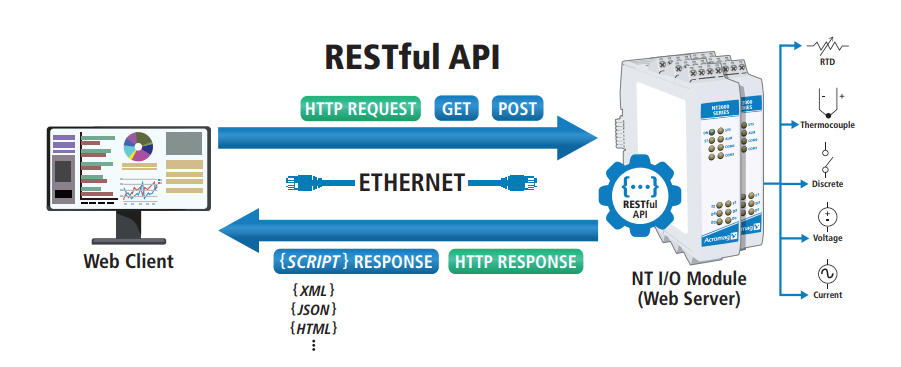
This application note reviews what a RESTful API is and introduces the new BusWorks NT Series RESTful API. This API simplifies web service development by enabling straightforward data transfer between I/O modules and network clients. The API allows users to interact with the modules using standard HTTP methods, making it easier to integrate with web-based applications and services.


Topics covered include:

  • The two HTTP Request Methods Used by the Simplified NT RESTful API
  • How to execute a curl script to test your Windows curl installation
  • Getting Started Sending Command Lines to the NT RESTful API Using cURL
  • HTTP Command Requests to the NT RESTful API: Various command requests are reviewed in detail, including example requests/responses.
  • Preventing Error Messages When Using cURL to Make Requests to an NT Server


Download the PDF document to read the entire application guide