Have You Considered These Factors for Belt Drive Applications?
When applying a belt drive, especially in vertical applications that involve significant loads, understanding the design considerations and potential failure points is crucial. Here, we explore the dynamics, considerations, and best practices for deploying belt drives in such demanding situations.
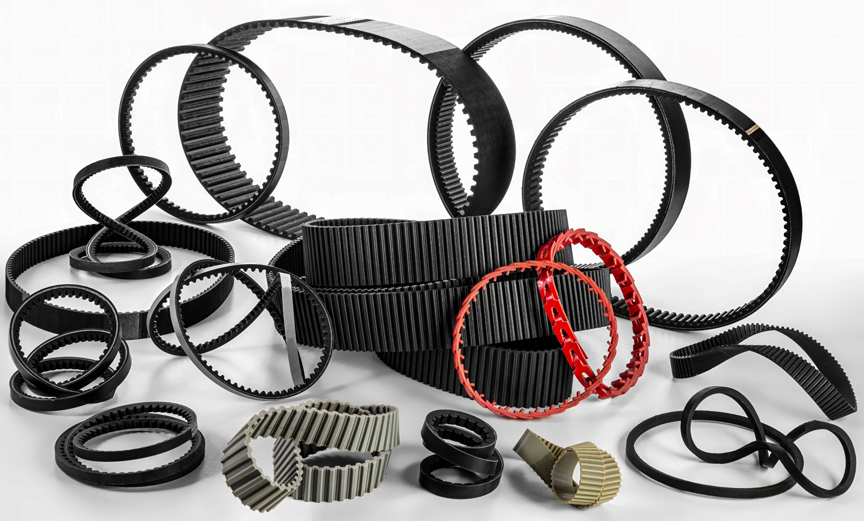
The Core Challenge: Load and Acceleration
A vertical belt drive must be equipped to handle not just the weight of the payload but also the forces associated with rapid acceleration. In my experience, the belt itself often becomes the limiting factor in such configurations. Most belts used in industrial settings are reinforced with materials like Kevlar or steel, giving them substantial tensile strength. The ratings for these belts dictate their maximum load capacity and performance.
Take, for instance, a belt rated for 1,000 lbs of force. In these cases, maintaining proper tension is key for consistent repeatability. As tension increases, so does the system's repeatability. However, ensuring that acceleration forces don't exceed these limits is essential to preventing issues.
Common Issues: Belt Jumping vs. Catastrophic Failure
Over decades in the field, I’ve rarely witnessed a belt snapping under load. Instead, the more frequent challenge is belt teeth jumping—a scenario that can happen during an emergency stop or sudden, forceful movements. In cases of such tooth-jumping, diagnosing the problem is straightforward. For example, if a 10mm pitch belt slips, the displacement will align with that pitch, making it relatively easy to identify and troubleshoot.
Another critical factor is the belt-to-pulley contact ratio. For optimal performance, ensuring that a significant number of teeth remain in contact with the pulley is essential. A drive system with, say, 30 teeth on the pulley should ideally have at least half engaged at any given time to prevent slippage.
Comparing Profiles and Ratings
Various belt profiles offer unique benefits. One series, for instance, features a thicker tooth structure, which provides enhanced strength and reduces the likelihood of skipping. This difference in design helps ensure that even under high load and stress, the belt remains firmly engaged with the pulley.
In practice, I’ve found that when comparing two similar belts—say, one with 20 teeth in contact and another with 28—the one with more teeth engaged performs better under high stress. This holds true even if the tooth profile and pitch remain the same across different manufacturers.
Belt Profiles Across Brands
Some manufacturers, like Brands A and B, have established reputations for robust belt-driven systems. Brand A’s profile, for example, has proven reliable across numerous applications. While specific data such as maximum transmittable force might not always be provided, comparing the number of teeth engaged and the overall design can provide insight into a belt's capability.
Brand B often shares comprehensive data, including the number of teeth and maximum force ratings, allowing for an accurate assessment of performance. When such data isn't readily available from other suppliers, reviewing known specifications and extrapolating from practical experience becomes invaluable.
Final Thoughts: Leveraging Experience for Design Assurance
Designing with belts in vertical load applications requires a balance of theoretical understanding and hands-on expertise. Always consider the engagement, pitch, width, and materials when selecting or comparing belt drives. While published specs provide a solid foundation, practical insights gained over years of experience can guide fine-tuning and adaptation in unique or high-stress scenarios.
In essence, while total belt failure is rare, understanding and mitigating tooth skipping, ensuring proper tension, and optimizing belt-to-pulley engagement are keys to successful vertical belt drive application.
Need help selecting the right belt drive? Speak to one of our technical specialists today at (855) 737-4716 or fill out our online form and one of them will contact you.
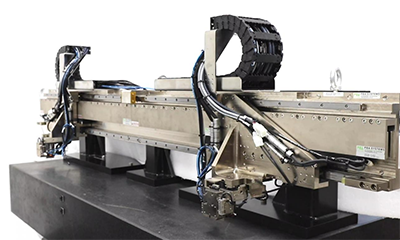
Dual Carriage XXYYZZ Pick and Place Stage
 This 6-axis precision pick and place stage system was engineered by PBA Systems from the ground up and delivered in 10 weeks. This high-performance stage system was designed to optimize throughput, size and cost, without sacrificing positioning performance. It features high performance ironless linear motors on the X and Y axes with linear voice coils on the Z axes. All surfaces have an electroless nickel coating for optimal ESD performance.
Key Applications:
- High-speed pick and place
- Electronic components assembly
- Surface mount technology applications
Specification | Unit | X | Y1, Y2 | Z1, Z2 |
Axis Orientaton | -- | Bottom | Top | Vertical |
Stroke | mm | 465 | 50 | 9 |
Maximum Velocity | mm/s | 3000 | 1000 | 1000 |
Maximum Accelaration | m/s^2 | 1 | 1 | 1 |
Overall stage weight | kg | 124 | ||
Payload | g | 550 | ||
For more information please call (855) 737-4716 or fill out our online form and one of them will contact you.
Quickly Get Custom Engineered High-Precision Motion Control Solutions
 Do you need custom-engineered high-precision motion in a hurry? Our team has done amazing work delivering complex and high-precision motion control solutions in very short time frames.
The engineering of systems such as this can take weeks to complete, even months if the customer isn’t sure about their application requirements. However, with the right expertise and a well-structured process, we can accelerate this timeline without sacrificing quality or precision.
How Do We Do It?
- Deep Engineering Expertise: Our motion control specialists understand every aspect of precision automation, from actuators and motors to advanced servo control systems.
- Strong Supplier Network: We leverage high-performance automation components and partners.
Why Speed Matters
In industries like semiconductor manufacturing, biomedical equipment, and precision assembly, delayed motion control projects can mean missed market opportunities and lost revenue. Our accelerated engineering and delivery process ensures that you stay ahead of your competition.
Examples
Here is a Dual Carriage XXYYZZ Pick and Place system that was designed and delivered in just 10 weeks!
Need a Solution Now?
If you have a high-precision motion challenge and need a fast turnaround, contact us today. We’ll work with you to define your requirements and put together a custom-engineered solution—delivered on time, every time.
For more information please call (855) 737-4716 or fill out our online form and one of them will contact you.