Pressure Gauge Know-How: Difference Between NPT and G Connections

WIKA
WIKA Pressure Gauge Know-How: Difference Between NPT and G Connections


Have you ever looked at a pressure gauge in a pipe assembly and wondered which connection type it has? Perhaps you have to replace a measuring instrument or need to buy a new one. One way to find out is to remove it from the installation and look at its threads, but this will result in downtime if the process is active. There is an easier way to tell whether a gauge has an NPT or G connection.

NPT Connections in Pressure Gauges

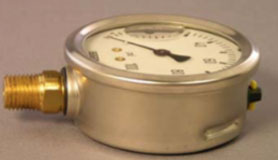
WIKA 1/4-inch NPT ConnectionMost of the time, the answer depends on geography. In the U.S. or Canada, the pressure gauge will most likely come with an NPT (National Pipe Tapered) connection. This thread type, standardized by ANSI (American National Standards Institute) and ASME (American Society of Mechanical Engineers), is typical among North American measuring instruments, found in piping systems, pumps, compressors, plumbing systems, mobile working machines, and many more applications.

Male (external) NPT connections are somewhat conical, with the diameter of the threads decreasing slightly from socket to tip. Tapered threads seal along the flanks of the thread. Due to the spiral leak path, however, Teflon® tape (PTFE) or a sealing compound is required to create a good seal. The most common sizes for pressure gauge connections in the U.S. are ⅛-inch NPT, ¼-inch NPT, and ½-inch NPT.

The U.S. and Canada also use parallel threads like the NPSM (National Pipe Straight Mechanical) connector. However, this thread type is typically found as a female (internal) component in non-pressurized devices like thermowells.

The tapered shape of the NPT threads allows users to continue turning the connection several more degrees after making the seal, until the instrument reaches the desired position. Tightening, though, has to be done with care: Too much compression can lead to galling, and over-tightening can damage the threads. These situations are problematic in applications that require regular installation and removal of the pressure gauge.


G Connections in Pressure Gauges

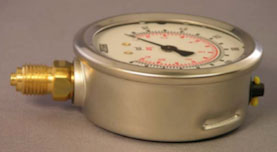
WIKA G 1/4-inch B ConnectionIf the pipe assembly is in Europe, Asia, or Latin America – basically anywhere else in the world but the U.S. and Canada – the pressure gauge will very likely have the straight threads of a British Standard Pipe Parallel (BSPP) connector, denoted by the letter G*. The tapered variants from the BSP classification system are denoted by ISO7, for example, R1/4-ISO7.

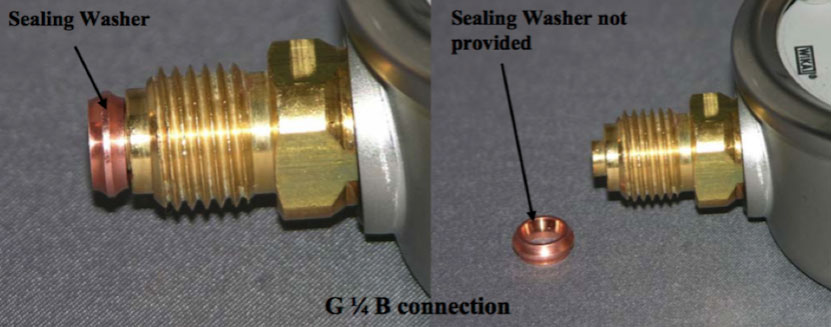
They are often referred to as metric connections because they are used in the metric system, and the dimensions are based on metric measurements. G connections have a straight body (constant diameter) with parallel (straight) threads. The main purpose of the parallel threads is to contain the pressure, which allows for regular installations and removals without damaging the thread. A sealing washer is required to seal the connection. As sealing of the connection takes place on the washer and not on the thread itself, no sealing compound or PTFE tape is required.

WIKA Sealing washer on a pressure gauge with a G Connection


Since the thread of a G connection will bottom out at the wrench flat, no threads are left exposed. Once the connector bottoms out to make the seal, the positioning of the instrument cannot be changed. To avoid the problem of awkward gauge positioning, use a “crush washer” and hand-tighten the connection. At the resistance point, approximately 1½ turns are left before the crush washer flattens out. This leeway allows the user to fine-tune the pressure gauge’s final position with a wrench**. If the position of the instrument is not critical, a flat washer can be used instead.

Eyeballing the Difference Between NPT and G Connections

When placed side by side, the difference between the two connection types is clear. The NPT thread is slightly tapered, while the G connection is straight. Another obvious visual: The G connector ends with a small protrusion (nipple), used to center the gasket. If calipers are handy, a third method is to measure the angle between threads: NPT threads are 60°, while BSP threads are 55°.

But how about when the pressure gauge is already inserted into the process? Is there an easy way to tell which connector type an instrument has without removing it? Yes. Because a G connection bottoms out, no threads are visible. In an NPT connection, a few threads or exposed PTFE tape can be seen.
 

NPT vs. G Connections

 NPT ConnectionsG Connections
Thread ShapeSlightly aperedStraight
Tip of threadBluntSmall protrusion (nipple)
Thread angle60°55°
Visual when assembledVisible thread or PTFE tapeNo exposed thread

Talk to one of our experts today at (855) 737-4714, or fill out our online form to learn more. 

Six Common Causes for Thermocouple Temperature Measurement Errors

WIKA
WIKA Six Common Causes for Thermocouple Temperature Measurement Errors

Thermocouples are robust temperature measurement devices that are accurate enough for many industrial and scientific applications. Relatively inexpensive compared to other temperature measurement technologies, thermocouples are valued for their ability to measure a wide temperature range: from –200° to +1250°C (–328° to +2282°F).

Thermocouples measure temperature differentials, not absolute temperatures. Two wires, each made from a different metal, are joined at the tip. This is the measuring junction. At the other end, the wires are connected to a body of a known temperature, called the reference junction. A thermocouple works by taking the difference in voltage between the two junctions, explained by the Seebeck effect. The measured voltage is converted into a temperature unit, with the temperature reading displayed on a device or transmitted to a remote location.

Although thermocouples are reliable, temperature measurement errors can occur for various reasons. The following are the six most common causes of thermocouple measuring errors, followed by ways to rectify them:


1. Selecting the Wrong Type of Thermocouple on the Transmitter

You can run into problems if you choose the wrong type of thermocouple when inputting the settings into the transmitter during installation. This is a common error, as there are numerous types of thermocouples – types K, J, N, E, T, R, S, and B – each with a different range, accuracy, and electrical output.

Solution: Almost all thermocouples are color-coded by type, so you usually just need to confirm the color of the thermocouple jacket and match the settings on the transmitter.

For a quick reference on thermocouple color codes, including international standards, download our chart.


2. Problems Related to the Thermocouple Extension Wire

If you accidentally reverse the polarity of the thermocouple lead wires, the measured temperature will be incorrect by the difference in temperature between the two ends of the leads. The problem is understandable because red is the usual color for positive charges, whereas the red wire in thermocouple cables typically contains the negative signal. This coloration is the ANSI standard for thermocouples, but it is not what most people expect.

Solution: Double-check the connection and, if necessary, swap the thermocouple lead wires.


3. Inherent Variations in Alloys

No two batches of wires are exactly alike. As the alloy percentages vary a tiny bit during each manufacturing process, some error in thermocouple accuracy is unavoidable. Standard thermocouples get within approximately 1% of the actual temperature at the measuring junction, which is accurate enough for most applications.

Solution: Order thermocouples with special-limit wires, which can improve accuracy twofold. These wires are manufactured at the highest tolerances to ensure the fewest possible impurities and the greatest consistency in alloy ratio.


4. Temperature Variations Around the Reference Junction Connection

Because a thermocouple measures temperature differentials, any temperature fluctuations around the reference junction (cold junction), which has the known temperature, result in an erroneous temperature reading.

Solution: Make sure no fans or other sources of cooling or heating are located near the reference junction. Simple insulation can also protect the junctions from extreme temperatures.


5. Thermocouple Grounded at More Than One Location

A thermocouple should be grounded at only one location. If it is grounded at more than one location, a “ground loop” can be created with current flowing through the thermocouple from one ground to the other. This is likely to generate electromagnetic fields, which can lead to radio-frequency-interference-related problems that can impact measurement accuracy.

Solution: Ground either the transmitter (connection head) or the controller/recorder, but not both. Selecting transmitters that have internal isolation between the input, output, and ground usually provides enough isolation to eliminate a ground loop. Loop isolators are also available and can be put in the loop wiring circuit to prevent this from happening.


6. Thermocouple Age

While thermocouples are reliable temperature measurement devices, they do drift with time. Maximum exposure temperature, cyclic measurements, and frequency of the cycles affect the metallurgy with a resultant drift, usually downward. Unfortunately, this drift cannot be predicted, but 10-20°F errors are common.

Solution: The only solution is to periodically replace the thermocouple based on the user’s experience.

Talk to one of our experts today at (855) 737-4714, or fill out our online form to learn more. 

Pressure Measurement: Understanding PSI, PSIA and PSIG

WIKA

WIKA Pressure Measurement: Understanding PSI, PSIA and PSIGPressure measurement is all about PSI. That’s because pounds per square inch (PSI) is the most common unit for measuring pressure in the U.S. It’s important to understand what PSI means and how it is used, as pressure measurement is an important part of life in the 21st century. For example, you need to make sure that your car tires or bicycle tires are inflated to the proper PSI before you drive or ride, and today, equipment of all types includes pressure sensors or gauges to assist in monitoring and diagnostic operations. Moreover, scores of careers, ranging from civil and mechanical engineers to meteorologists to refinery pressure instrument technicians, also involve understanding and using pressure measurements as a part of their daily activities.


Getting a Grip on Pounds per Square Inch — PSI

Pounds per square inch is the unit of pressure used the vast majority of the time in the United States for household, commercial, or industrial equipment. Other countries measure pressure in different units. In scientific contexts (physics labs and so forth), pressure is typically measured in much smaller units called pascals (named after French physicist Blaise Pascal). For reference, 1 PSI equals 6,894.76 pascals. Pressure measurement instruments such as pressure gauges and sensors typically display measurements in PSI. Two frequently used variations of PSI are PSIA and PSIG.


Pounds per Square Inch Gauge – PSIG Vs. Pounds per Square Inch Absolute – PSIA

PSIG

PSIG is the term for pressure specified by a gauge or other pressure measurement device. It gives the difference between the pressure in a pipe or tank and the pressure of the atmosphere (atm).

PSIA

PSIA is a term that describes the absolute pressure in PSI, including the pressure of the atmosphere. Absolute pressure is also sometimes referred to as “total pressure.”


Examples of How to Calculate PSIG and PSIA

Note that PSIG is always lower than PSIA. The formulas to describe the relationship are: PSIG + 1 atm = PSIA and PSIA – 1 atm = PSIG (where atm is atmospheric pressure). It is easy to calculate PSIA or PSIG or convert between the two. You can use the actual atmospheric pressure value for your location if it is available, or you can also use 14.7 psi (the approximate atmospheric pressure at sea level) as a standard value to convert PSIG to PSIA and vice versa. (Unless you live at a high altitude or in a deep valley, the sea level value will work.) In other words, since atmospheric pressure at sea level is 14.7 PSIA, you subtract the PSIA of 14.7 from an atm pressure of 14.7 to equal zero PSIG (14.7 (PSIA) –  14.7 (atm) = 0). As an example, absolute pressure at sea level is 14.70 PSIA, and absolute pressure at an elevation of 1,000 feet is 14.18 PSIA. At the higher elevation, there is less pressure, so if an absolute pressure gauge is read at a 1000-foot elevation, its readings will be close to 0.5 PSI (14.70 – 14.18 = 0.52) less than those from a standard pressure gauge.

Talk to one of our experts today at (855) 737-4714, or fill out our online form to learn more. 

Pressure Sensors, Pressure Transducers, and Pressure Transmitters: What’s the Difference?

WIKA
WIKA Pressure Sensors, Pressure Transducers, and Pressure Transmitters: What’s the Difference?


What‘s in a name? When it comes to electronic pressure sensing, the answer for many users is “not much.” Manufacturers do not always or consistently differentiate between a pressure transducer and a pressure transmitter, while some devices are simply called a pressure sensor. It’s easy to see why, as all three terms refer to functionally similar instruments that measure and convert the physical property of pressure into an electronic signal.

Other names for electronic pressure measuring instruments include I/P (current to pressure) converters and I/P transducers, P/I or P to I (pressure to current) converters, pressure senders, and pressure switches.

Some of these are legacy terms, part of the industry’s or manufacturer’s history, while for certain users, it’s a matter of personal preference. It’s little wonder that the market tends to lump together all devices with a wire and refer to them all as simply pressure sensors!


The Types of Electronic Pressure Measurement Instruments

The textbook definition of a transducer is an instrument that measures pressure, load, force, or other states, and converts the reading into an electronic signal. A transmitter also converts a reading into an electronic signal, but it then amplifies, modifies, and sends that signal to a receiver. A switch is a device that, based on a preset switch point, interrupts the current or diverts the current from one circuit to another.

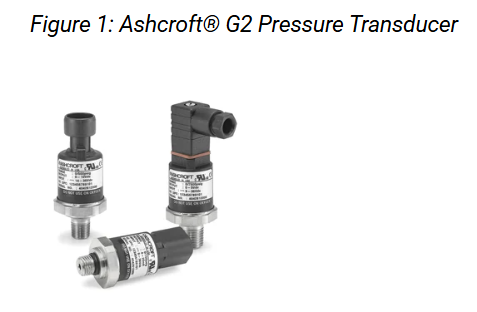
At WIKA, a transducer (like the TTF-1) has a non-amplified output, while a transmitter (like the A-10 or S-20) has an amplified output. Other electronic pressure devices are simply called a sensor, as this is an easy way to refer to next-generation instruments like the A-1200 with IO-Link or the MH-4-CAN with CANopen and SAE J1939 CAN communication protocols. All the above electronic pressure measuring instruments are listed under the category pressure sensors, while pressure switches are grouped separately.


Comparing Pressure Transducers and Transmitters

In a pressure transducer, a thin-film or piezo-resistive pressure sensor is mounted on a process connection. The transducer converts pressure into an analog electronic output signal, typically as a millivolt per volt output. These signals are not linearized or temperature compensated.

A pressure transmitter has additional circuitry that linearizes, compensates, and amplifies the signal from a transducer. The different signal types are typically voltage signals (e.g., 0 to 5 or 0 to 10 volts), milliamps (e.g., 4 to 20 milliamps), or digital. The instrument can then transmit the signal to a remote receiver.

Many pressure transmitters offer a variety of calibration options, including turndown and zero/span adjustment. Smart transmitters can be calibrated, tested, and reset remotely using a bus network.


Pressure Transducer or Transmitter: Which One to Choose?

Despite the amplified vs. non-amplified differences between transmitters and transducers, it really doesn’t matter what people call them or which ones they use. What’s more important is whether the device suits a particular application and offers the needed output. Accuracy, range, working temperature, and the medium are all determining factors when selecting the right pressure instrument for an application.


As for the output signal, here are some factors to take into account:

  • Typical mV outputs do not have temperature characterization.
  • A current signal is more immune to interference and noise than a voltage signal.
  • A current signal can also travel farther.
  • An analog signal is just the pressure reading.
  • A digital signal allows a user to collect more information and other variables besides pressure.
  • The input card of many control systems accepts only amplified signals.

The bottom line: Get the pressure device you need, regardless of what it’s called.

Talk to one of our experts today at (855) 737-4714, or fill out our online form to learn more. 
The Magnetic Level Indicator Working Principle: Simple and Effective

WIKA
WIKA Magnetic Level Indicator Working Principle


The magnetic level indicator working principle is based on the effects that one magnet has on nearby magnets. The mechanics are simple yet very effective, yielding reliable and repeatable level information for continuous monitoring and recording of fluid levels.

What Is the Magnetic Level Indicator Working Principle?

WIKA Magnetic Level Indicator Working PrincipleThe working principle behind a magnetic level indicator is that the measuring instrument shares the same fluid — and therefore, the same level — as the vessel. The level indicator is attached to the vessel and connects directly with the fluid to be measured. Within the chamber is a float with a magnet assembly inside. This float rests on the fluid’s surface. As the fluid level rises or falls, so does the float. As the float moves up or down, the magnet assembly rotates a series of bi-color magnetic flags or flaps, changing the visual indicators mounted just outside the chamber from one color to the other.

Since the magnetic level indicator working principle relies on the interaction between magnets, these level measuring instruments do not need a power source. They are also virtually maintenance-free. An additional advantage: The indicator’s magnetic force can affect optional switches or transmitters mounted outside of the chamber. The colored flags are easy to see, even from a distance, and are paired with a scale for precise readings. As for any level instrumentation, the size and material of the float are chosen according to the media, temperature, pressure, and density of the process media.

WIKA’s High-Performance Magnetic Level Indicators

WIKA has over 60 years of experience in this field, as our subsidiary KSR-Kuebler obtained one of the first patents for a magnetic level indicator. WIKA manufactures the WMI series, a complete line of high-quality magnetic level indicators that provide years of accurate level information. The float in each MLI is designed for each application. The materials of the float magnet are carefully chosen to minimize the size of the float and the chamber, and to provide the best coupling for the particular pipe wall material and thickness. Bypass chambers can be made of several different types of stainless steel and alloys (Hastelloy®, Inconel®, etc.) and other materials (Teflon™, PVC, etc.) to suit media and process temperature.

Model WMI magnetic level indicators are highly adaptable. They work from −320°F to 1,000°F (−195°C to 537°C), from full vacuum to 5,000 psi (344 bar), and for specific gravities as low as 0.35. Indicator flags can be red–white, yellow–black, or fluorescent. The scales can be indicated as imperial units (feet/inches), metric units (mm/cm/m), percentages, or even customized to your specific requirements. You can also choose from several process connections, connection sizes, vents, and drains. Other useful options include high-temperature insulation and cryogenic insulation.

WMI magnetic level indicators fit most industrial and commercial applications in:

  • Refinery and chemical industries
  • Energy and power plant technology
  • Feed water heaters and boilers
  • Oil and gas industries
  • Offshore exploration and drilling
  • Pipeline compressor applications
  • Pulp and paper
  • Food and beverage
  • Gas plants
  • Pharmaceutical

A level instrument based on the magnetic level indicator working principle can give you the accuracy and reliability you need. WIKA can help you find the best one for your application.

Talk to one of our experts today at (855) 737-4714, or fill out our online form to learn more. 

Tips for Correctly Installing Pressure Gauges

WIKA
Tips for Correctly Installing Pressure Gauges from WIKA


Are your gauges installed properly? WIKA’s industry experts know that all too often this isn’t the case. Improperly installed gauges can lead to premature gauge failure and prevent you from troubleshooting issues with equipment or processes. Don’t let this happen at your plant. Use these six tips for proper gauge installation.

1. Select the Right Gauge

Before you pull out a wrench, first make sure you have the right type of gauge for the application. The pressure gauge you choose must be the correct one for the:

  • Expected pressure range to be measured. The selected range should be double the operating range.
  • Process media compatibility.
  • Process temperature
  • Severe operating conditions (e.g., vibrations, pulsations, pressure spikes).

However, even if you install the gauge perfectly, you could face the same problems you had before the installation if the gauge isn’t the right one for the job.

2. Apply Force on Wrench Flats

Once you’ve chosen the correct gauge, pay attention to how you install the gauge. Rather than turning the case by hand, use an open-end wrench and apply force to the wrench flat. Applying the force through the case could damage the case connection as well as the gauge internals. Not applying sufficient torque could result in leaks.

3. Seal the Deal

Notice the type of threads on the gauge before you seal it. If the gauge has parallel threads, seal it using sealing rings, washers, or WIKA sealing rings (crush rings). If the gauge has tapered threads, additional means of sealing, such as PTFE tape, are recommended. This is standard practice for any pipe fitter because tapered threads do not provide complete sealing on their own.

4. Use a Clamp Socket or Union Nut with Straight Thread

When tapered threads are used, the installer has the luxury of adjusting the gauge even after sufficient torque has been applied. This allows for convenient orientation of the gauge face. However, with straight threads, the face orientation is not adjustable once it bottoms out. For that reason, we recommend using WIKA sealing rings (crush rings) instead of flat washers. The WIKA sealing ring allows you to correctly orient the gauge after the socket has been seated on the sealing ring. You start by tightening the gauge by hand. As soon as you encounter a resistance, apply an open-end wrench to the wrench flat and continue turning the gauge. At this point, you have approximately one turn left to put the gauge into the desired position.

5. Leave Space for Blow-out

For personnel safety, some gauges come with a safety pattern design consisting of a solid wall between the front of the gauge and the Bourdon tube, and a blow-out back. In the event of a pressure build-up inside the case or a catastrophic Bourdon tube rupture, all the energy and release of media will be directed to the back of the gauge, thus protecting the people reading the gauge. In order for the safety device to function properly, it is important to keep a minimum space of 1/2 inches. WIKA XSEL® process gauges come standard with integrated pegs to ensure this distance when mounting the gauge against a surface.

6. Vent the Gauge Case

Some gauges come with a small valve on top of the case. Users who don’t understand the purpose of the valve are confused about why it’s included. During shipment, liquid-filled gauges can go through temperature changes that create internal pressure build-up. This can cause the gauge pointer to be off zero. When installing the gauge, open the compensation valve to allow this pressure to vent. It should then be closed again to prevent any external ingress. After you mount the gauge, set the compensating valve from CLOSE to OPEN.

A pressure gauge can do its job only if it’s installed properly. Whether you’re an operator or a maintenance technician, use these tips for proper gauge installation to make sure your gauges perform as they should.

Talk to one of our experts today at (855) 737-4714, or fill out our online form to learn more. 
8 Common Reasons For Pressure Gauge Failure

WIKA

Pressure gauges are an integral part of an application’s warning system. By constantly measuring pressure, these instruments allow users to see how a process is doing. Gauges are sturdy and can handle challenging conditions. However, even the toughest instruments will experience failure if they weren’t designed for a specific application or condition.

At WIKA USA, our customers often ask us why their gauges are damaged or stopped working properly. With decades of pressure experience, we have seen all the causes of pressure gauge failure.
 

diagram of a bourdon tube pressure gaugeHow A Pressure Gauge Works

Before getting into why things go wrong and how to troubleshoot the problem, it’s important to first understand the inner workings of a mechanical gauge, the most popular of which is the Bourdon tube pressure gauge.

The Bourdon tube is a hollow C-shaped spring element within the case. As the tube is pressurized from the media entering it, it starts to move – like a balloon trying to equalize. This movement is translated through the connecting link, attached to the Bourdon tube via the end piece, into a pressure measurement that the pointer indicates on the dial.
 

8 Causes of Gauges Failure

When a pressure gauge doesn’t work as expected, the cause can be traced back to at least one of these eight reasons:


1. Mechanical vibration

Numerous studies have shown that vibration is the main cause of pressure gauge failure in manufacturing facilities. Vibration has a negative impact on gauge accuracy in two ways. First, it is difficult to read the pointer on a dial when a gauge is vibrating. Second, incremental damage to the pointer mechanism from vibration can eventually move a pointer off zero, producing inaccurate readings.

Visible signs of mechanical vibration

  • Metal filings/dust, like a halo, inside the gauge window from worn pinion and segments gears
  • Detached pointer if the vibration is severe
halo inside gauge window, detached pointer


Risks posed by mechanical vibration

  • Wear and tear of internal components
  • Loss of accuracy/functionality
  • Pressure system failure
     
worn pinion gear; worn segment gear


Solutions for gauges experiencing mechanical vibration

model 990.28 diaphragm sealFor most situations, a liquid-filled case is the most convenient and cost-effective way to protect pressure gauges from vibration. The glycerin or silicone-oil case fill acts as a damper to slow down the movement. It also lubricates the pinion and segment gears, thereby reducing wear and prolonging the life of a gauge.

A second solution is to move the gauge away from the source of the vibration. How? Use a diaphragm seal with capillary connection, like the 990.28 cell-type (sandwich) seal. A diaphragm seal can be mounted practically anywhere in the application, and the line allows for remote reading. (See this video and blog for more info on how diaphragm seals work.)


2. Pulsation

pointer fultterVibration refers to regular oscillation of mechanical parts. Pulsation, on the other hand, is regular instances of rapid pressure increases and decreases of the media.

Visible signs of pulsation

  • Pointer flutter
  • Loose or broken pointer in extreme cases

Risks posed by pulsation

  • Difficulty in obtaining an accurate reading
  • Wear and tear of internal components
  • Loss of accuracy/functionality
  • Pressure system failure

Solutions for gauges experiencing pulsation

As with mechanical vibration, a liquid-filled case is an easy solution. So are valves and protective devices like a socket restrictor. This small device has a small orifice to restrict and slow down the pressure of the media before it encounters the gauge. Restrictors are cost-effective and easy to install. Several gauges, like model 111.11 for compressed gas regulators, come standard with a restrictor already threaded into the bore.

For more extreme pulsation, use a snubber or needle valve. Snubbers function like restrictors but come in more material choices, orifice sizes, and psi ratings. Snubbers are also less prone to clogging and are more adjustable in the field, thanks to interchangeable pistons or adjustment screws. Needle valves also throttle the media, thereby reducing the impact of pulsations. These pulsation dampeners are commonly found in pump discharge and boiler house applications.


3. Extreme temperature

gauge discolorationDifferent gauges have different tolerances for extreme temperatures. We look at both ambient temperatures, such as what is found in the Arctic or around a furnace, and the temperature of the process media.

Visible signs of extreme temperature

  • Dial and/or liquid fill is discolored, usually yellow, orange, brown, or black
  • Dial, case, or window is melted – usually because the media is too hot

Risks posed by extreme temperature

  • Difficulty in obtaining an accurate reading
  • Loss of accuracy/functionality
  • Pressure system failure

Solutions for gauges in extreme temperatures

model 910.32.250 mini cooling adapterA diaphragm seal with capillary allows pressure measurement to occur away from extreme ambient or media temperatures. The longer the run, the more heat is dissipated before the pressure reaches the gauge. Or attach a cooling adapter like the 910.32.200 (up to 500°F/260°C) or 910.32.250 (up to 700°F/370°C). With fins to increase the surface area, these adapters are very effective at radiating and dissipating heat. They’re also extremely easy to retrofit using threaded connections. Pigtail, coil, and mini (rod and cap) siphons use the same principle to dissipate heat.

Glycerin is the typical fill fluid for pressure gauges. For extremely hot or cold ambient temperatures, silicone oil is the better choice as it will not discolor in heat over time or freeze in sub-zero environments.


4. Pressure spikes

Spikes occur when the pressure sharply increases and then suddenly drops. This condition can cause all sorts of problems for gauges not designed for this condition.

bent pointerVisible signs of pressure spikes

  • Bent pointer, like a fishtail or fish hook, from hitting the stop pin too often
  • Nicked or broken pointer from hitting the stop pin too hard
  • Broken stop pin

Risks posed by pressure spikes

  • Increased wear on movement and components
  • Loss of accuracy/functionality
  • Split Bourdon tube, leading to released media
  • Pressure system failure

Solutions for gauges experiencing pressure spikes

As with pulsation, good solutions for dampening the effects of pressure spikes are to use a liquid-filled gauge and/or accessories like restrictors, snubbers, needle valves, or diaphragm seal with capillary. Another way to prevent damaged pointers and internals is to replace the gauge with one that has a higher pressure range. A good rule of thumb is to choose a gauge that is two times the expected pressure maximum. So, if a process typically reaches 500 psi, use one that goes up to 1,000 psi.

For greater reassurance that a gauge never exceeds a certain maximum, attach an overpressure protector to the instrument. This unique option allows the user to changing the maximum pressure setting. If the pressure ever reaches that value, the protector’s spring-loaded piston valve will automatically close, preventing the gauge from experiencing the spike. And when the system pressure drops approximately 25% below pre-set maximum, the valve with automatically reopen.


pointer buried against stop pin5. Overpressure

This situation is very similar to pressure spikes, but occurs when the gauge regularly measures pressures near or at the maximum range. We typically see this condition in water/wastewater treatment and gas lines.

Overpressure can cause the Bourdon tube to deform and split. This is major problem because a rupture allows caustic media, such as the hydrofluoric (HF) acid in alkylation units, to escape. In pharmaceutical manufacturing, a rupture event ruins very expensive product and leads to shutting down the line, quarantining the product, and re-sterilizing the process.

Visible signs of overpressure

  • Pointer buried against stop pin
  • Pointer dislodges stop pin

Risks posed by overpressure

  • Increased wear on movement and components
  • Loss of accuracy/functionality
  • Split Bourdon tube, leading to released media
  • Pressure system failure

model 910.13 overpressure protectorSolutions for gauges experiencing overpressure

As overpressure is similar to pressure spikes, so is the fix: use a gauge with a higher pressure range, and attach an overpressure protector.


6. Corrosion

Many industries work with harsh chemicals: hydrofluoric acid in refineries, flocculants and chlorine in wastewater treatment, chlorinated gases in fiber optic production, and so on. These media find their way into gauges.

corroded pressure gaugeVisible sign of corrosion

  • Discoloration and deterioration of the gauge case, pointer, connection, and dial

Risks posed by corrosion

  • Loss of accuracy/functionality
  • Pressure system failure

Solutions for gauges in corrosive environments

Isolate the gauge from harsh chemicals by using a diaphragm seal made of the appropriate corrosion-resistant materials. WIKA’s diaphragm seals come in a variety of standard and exotic alloys for both the wetted and non-wetted parts: 316L and 316 TI stainless steels, Hastelloy®, Monel®, Inconel®, tantalum, and titanium. The metals can be left as-is or, for extra protection, lined with Teflon® or plated with gold. When deciding on the materials for your diaphragm seals, look at what the existing wetted parts are made of, and choose those.


clogged pressure gauge7. Clogging

Clogging is an issue for paper plants, wastewater plants, pharmaceuticals, and other industries, as slurry, pulpy, viscous, and high-particulate media can gum up the system.

Visible sign of clogging

  • Gauge at or near zero when the system is operating

Risks posed by clogging

  • Loss of accuracy/functionality
  • Possibility of overpressure

Solutions for gauges measuring clogging media

Again, use a diaphragm seal to separate the gauge from the challenging media. An excellent solution is WIKA’s All-Welded System (AWS), an assembly comprising an XSEL® industrial process gauge permanently welded to a bell-shaped diaphragm seal.

As the AWS still has a small orifice that the media can enter, customers can opt for versions with a flushing port. This component allows operators to clear away media either when clogging occurs or during regular maintenance.

Another solution is WIKA’s INLINE™ diaphragm seals, which has smooth walls for full flow-through. By eliminating dead spaces, there’s no risk of media buildup.
 

8. Mishandling/abuse

Gauges look sturdy, especially the larger process gauges, but they are not designed to be handles or footholds! During site visits, we often see evidence of gauge mistreatment. Operators might grab on to a gauge as they move around process skids on wheels, or step on them as they climb scaffolding. Not only is this practice unsafe, it increases the chances of gauge damage and failure.

pressure gauges with broken window and cracked case

Visible signs of mishandling/abuse

  • Cracked case
  • Broken window
  • Loss of case filling
  • Crooked or bent gauge and/or process connection

Risks posed by mishandling/abuse

  • Loss of functionality

Solutions for gauge mishandling/abuse

Training is the best prevention. Employees should be aware of the dangers of mishandling gauges. They should also know how to properly connect gauges. For example, when threading the gauge onto the process, some people tighten it by hand, which risks torquing the case. When the NPT or G connection has a wrench flat area, use a wrench to tighten the gauge.

WIKA USA’s pressure specialists have decades of experience diagnosing why gauges fail, and then coming up with solutions so that instruments last longer. When the causes aren’t obvious, we encourage customers to take advantage of our Instrument Failure Analysis (IFA) program. Send the failed gauge to our facilities in Lawrenceville, Georgia, and our engineers will conduct a full evaluation on the nonfunctioning gauge – all free of charge. Contact WIKA USA for more information about why pressure gauges fail and what you can do to solve the problem.

Talk to one of our experts today at (855) 737-4714, or fill out our online form to learn more.

Pt100 and Pt1000 Sensors: Important Facts and Differences

WIKA

WIKA Pt100 and Pt1000 SensorResistance temperature detectors (RTDs), also called resistance thermometers, are popular temperature measurement devices due to their reliability, accuracy, versatility, repeatability, and ease of installation.

The basic principle of an RTD is that its wire sensor – made of a metal with a known electrical resistance – changes its resistance value as the temperature rises or falls. Although resistance thermometers have certain limitations, including a maximum measuring temperature of about 1,100°F (600°C), overall they are the ideal temperature measurement solution for a multitude of processes.

Why Use a Platinum Sensor

The sensing wires in an RTD can be made of nickel, copper, or tungsten, but platinum (Pt) is by far the most popular metal used today. It’s more expensive than other materials, but platinum has several characteristics that make it particularly well-suited for temperature measurements, including:

  • Almost linear temperature–resistance relationship
  • High resistivity (59 Ω/cmf compared to 36 Ω/cmf for nickel)
  • Non-degradable electrical resistance over time
  • Excellent stability
  • Very good chemical passivity
  • High resistance to contamination

To learn more about the relation between temperature and resistance in platinum RTD sensors, download the WIKA temperature table.

The Difference Between Pt100 and Pt1000 Sensors

Among platinum RTD sensors, Pt100 and Pt1000 are the most common. Pt100 sensors have a nominal resistance of 100Ω at ice point (0°C). Pt1000 sensors’ nominal resistance at 0°C is 1,000Ω. Linearity of the characteristic curve, operating temperature range, and response time are the same for both. The temperature coefficient of resistance is also the same.

However, due to the different nominal resistance, readings for Pt1000 sensors are higher by a factor of 10 compared to Pt100 sensors. This difference becomes evident when comparing 2-wire configurations, where lead measurement error is applicable. For instance, the measurement error in a Pt100 could be +1.0°C, and in the same design a Pt1000 could be +0.1°C.

How to Choose the Right Platinum Sensor

Both types of sensors work well in 3- and 4-wire configurations, where the additional wires and connectors compensate for the effects of the resistance of the lead wires on the temperature measurement. The two types are also similarly priced. Pt100 sensors, however, are more popular than the Pt1000 for a couple of reasons:

  • A Pt100 sensor comes in both wire-wound and thin-film constructions, offering users choice and flexibility. Pt1000 RTDs are almost always only thin-film.
  • Because their use is so widespread across industries, Pt100 RTDs are compatible with a large range of instruments and processes.

So, why would someone opt for the Pt1000 sensor instead? Here are the situations where the greater nominal resistance has the clear advantage:

  • A Pt1000 sensor is better in 2-wire configurations and when used with longer lead wire lengths. The fewer the number of wires and the longer they are, the more resistance is added to the readings, thereby causing inaccuracies. The Pt1000 sensor’s greater nominal resistance compensates for these added errors.
  • A Pt1000 sensor is better for battery-operated applications. A sensor with a higher nominal resistance uses less electrical current and, therefore, requires less power to operate. Lower power consumption extends battery life and the interval between maintenance, reducing downtime and costs.
  • Since a Pt1000 sensor uses less power, there is less self-heating. This means fewer errors in the reading as a result of higher-than-ambient temperatures.

In general, Pt100 temperature sensors are more commonly found in process applications, while Pt1000 sensors are used in refrigeration, heating, ventilation, automotive, and machine building applications.

Replacing RTDs: A Note About Industrial Standards

RTDs are easy to replace, but it’s not a matter of simply swapping one for another. The issue that users must watch out for when replacing existing Pt100 and Pt1000 sensors is the regional or international standard.

The older U.S. standard states platinum’s temperature coefficient as 0.00392 Ω/Ω/°C (ohm per ohm per degree centigrade). In the newer European DIN/IEC 60751 standard, which is also used in North America, it’s 0.00385 Ω/Ω/°C. The difference is negligible at lower temperatures, but becomes noticeable at the boiling point (100°C), when the older standard will read 139.2Ω while the newer standard will read 138.5Ω.

Talk to one of our experts today at (855) 737-4714, or fill out our online form to learn more.

Have You Integrated Your Z and Theta Motions Into One Compact Actuator?

Valin Corporation

 PPH Integrated Z-Theta Picker Head Actuator from PBA SystemsMotion architecture may look fine on paper until the cycle rate increases, the available space shrinks, and the “simple” pick-and-place head becomes far more complicated than expected. That is often when the real cost of stacking separate axes becomes clear: a Z stage here, a rotary stage there, more cabling, more alignment work, and more opportunities for drift over time.

That is why integrated solutions like the PPH Integrated Z-Theta Picker Head Actuator from PBA Systems deserve serious consideration. This compact motion actuator combines vertical Z-axis travel and rotary theta motion in one unit, built specifically for high-speed, high-precision automation environments.


The problem with traditional Z + rotary stacks in pick-and-place systems

In many semiconductor and SMT machines, the picker head is doing two jobs at once:

  • moving up and down rapidly (Z-axis motion)
  • rotating for alignment (Theta-axis motion)

The traditional approach is to bolt together multiple stages. And that approach works… until performance limits are pushed. The more axes that are stacked, the more the system introduces:

  • extra height in the machine
  • mechanical tolerance buildup
  • alignment challenges
  • tuning complexity
  • long-term maintenance concerns

In space-constrained automation, these compromises show up quickly.


A compact integrated Z-Theta actuator: what the PPH does differently

The PPH actuator integrates Z and Theta motion into a single compact 15 mm body, immediately simplifying picker head architecture. Instead of coordinating separate actuators, machine builders gain one clean module designed for:

  • high-speed pick-and-place
  • precision alignment
  • tight machine envelopes
  • scalable multi-head configurations

This type of integration decision often makes the rest of the machine easier to design, assemble, and support.


Precision performance that matters in production

Specifications only matter if they hold up in real automation environments.

The PPH platform is built around the motion performance required for semiconductor handling and micro-component placement:

  • 0.1 µm resolution
  • ±0.5 µm repeatability on the Z-axis
  • Theta repeatability of ±0.005°
  • Rotary speeds up to 3,000 RPM (page 2 technical specifications)

That level of control is essential when placing components that do not tolerate positioning errors.
 

Force-controlled soft landing: an underrated feature

One of the most valuable aspects of this actuator is not only speed, but controlled contact. The PPH supports force-controlled soft landing, allowing the head to approach quickly and then land gently.

In practical terms, this provides:

  • reduced part damage
  • improved yield
  • more consistent handling
  • higher throughput without excessive force

This capability is especially important in:

  • semiconductor pick-and-place
  • LED sorting
  • delicate inspection workflows (page 2 highlights this throughput advantage)


Designed for scalable multi-head automation

Many high-volume production machines do not stop at one picker.

PBA designed the PPH platform to scale from:

  • a single pick head
  • to multi-head arrays (10+ heads)

The system also supports:

  • embedded encoder feedback
  • vacuum suction integration
  • modular configurations for production equipment (page 1 product benefits and features)

This flexibility matters when automation platforms must evolve across multiple machine generations.


Where integrated Z-Theta motion is most valuable

The datasheet identifies several environments where compact Z-Theta actuators provide major benefits:

  • semiconductor automation and component pick-and-place
  • SMT and PCB surface mount equipment
  • automated optical inspection (AOI)
  • LED and micro-part sorting
  • precision Z-Theta alignment stations (page 1 applications list)

These are industries where motion performance is not a luxury — it defines the machine.


Closing thought: integration is often the real performance upgrade

In many automation systems, the limiting factor is not the motor or controller. It is the mechanical stack-up.


When axes are integrated cleanly, the system does not just save space — it reduces the number of places where compliance, drift, and accumulated error can enter.

The PPH Integrated Z-Theta Picker Head Actuator is a strong example of that philosophy: compact, precise, scalable, and designed for automation environments where motion truly makes the difference.


Talk with Valin about high-speed pick-and-place motion

If a semiconductor, SMT, or inspection system requires compact Z-Theta actuator integration, Valin’s automation team can support configuration selection, sizing, and application engineering.


Talk to one of our experts today at (855) 737-4716 or fill out our online form to learn more. 

Using a Differential Pressure Transmitter for Liquid Measurement

WIKA

The market offers several methods for measuring and monitoring liquid levels. For closed vessels, operators commonly choose a differential pressure transmitter. This is a proven technique, especially when the measuring instrument should not be immersed in the media, such as for tanks that have a grinder or hold aggressive substances. However, if the application requires high accuracy, this method of level measurement soon comes up against its limits.

Before making the case for using two interconnected process transmitters rather than other configurations or instruments, let’s take a look at what a differential pressure transmitter is and how this pressure instrument measures liquid levels.

How differential pressure transmitters workWhat Differential Pressure Transmitters Do

A differential pressure transmitter measures and calculates the difference between two points of pressures, and sends that information via a signal to a programmable logic computer (PLC).

These sensors were originally designed for use in pipes to measure pressure before and after the fluid encounters a filter, pump, or another interruption in flow. Standard differential pressure transmitters come with two process connections arranged side by side to measure the drop in pressure (d) between the higher and lower points (H and L, respectively, in Figure 1). Classic differential pressure transmitters can also measure flow rates.

It wasn’t long before people realized that differential pressure measurements could be used to determine liquid level as well.

Measuring Level with a Differential Pressure Transmitter: Advantages and Challenges

Level Measurement with a Differential Pressure TransmitterA differential pressure transmitter calculates level by measuring the differential pressure between the liquid and the gaseous phases of the fluid inside a closed tank. For precise calculations, important factors include:

  • Geometry of the tank (horizontal or vertical, shapes of various lids and bottoms, etc.)
  • Specific density of the medium
  • Hydrostatic pressure

The distance between points H and L in a tank is necessarily much longer than in a pipeline, necessitating the use of tubing to bridge that distance (Figure 2: Differential pressure transmitter configured to measure level inside a tank). But not just any size of tube will do. For accurate measurements, these small pipes – capillaries, really – have to be so thin and limited in volume that they transmit media without any changes in pressure.

However, using capillaries creates its own set of challenges. Within an enclosed system, the pressure of a gas is directly proportional to its temperature. This is Gay-Lussac’s Law. In larger pipes, an increase in temperature/pressure won’t have much effect on differential pressure readings. But within the confines of a capillary, any changes in temperature and, thus, pressure are magnified. Measurement solutions with this kind of connection to the measuring points are sensitive to temperature. In the worst-case scenario, severe fluctuations could result in falsely measured values.

Talk to one of our experts today at (855) 737-4714, or fill out our online form to learn more.