
OEM High-Pressure Transducers: A Comparative Review

High-pressure OEM systems depend on reliable, repeatable pressure measurement to maintain performance, protect equipment, and ensure operator safety. Whether used in mobile hydraulics, pump monitoring, transportation systems, or demanding industrial automation, an inaccurate or unstable pressure signal can lead to equipment damage, premature component failure, or inconsistent system behavior.
For decades, Ashcroft, together with its parent company Nagano Keiki Co Ltd., has been engineering pressure transducers to withstand the high shock and vibration, wide temperature swings and other extreme conditions of OEM applications. Read this to learn what makes OEM systems unique, the key performance factors that influence pressure transducer selection for OEM use and how the Ashcroft® S1 OEM Pressure Transducer and G2 Pressure Transducer meet these challenges. When you are done reading, you will know which model is the best fit for your system requirements.
What Makes High-Pressure OEM Applications Unique?
OEM environments present challenges beyond basic pressure measurement:
- Continuous exposure to shock and vibration: Common in construction machinery, mobile hydraulics, and performance equipment. Repeated mechanical stress can cause drift or failure if the sensor structure isn’t robust.
- Pressure spikes and high-cycle loading: Rapid cycling, water hammer, abrupt load changes, or pulsating hydraulic systems create sustained mechanical fatigue.
- Temperature extremes: High-pressure OEM systems often operate from sub-zero temperatures up to 257 °F, stressing sensor electronics and materials.
- Electrical noise: Hydraulic equipment, engine compartments, and industrial automation systems generate EMI/RFI interference that can impact signal integrity.
- High volumes and integration requirements: OEMs typically need configurable electrical terminations, process connections, and output options to fit diverse equipment designs.
Selecting the right high-pressure transducer means understanding not only pressure range and accuracy, but how durability, electrical compatibility, and long-term stability factor into system performance.
5 considerations for choosing an OEM high-pressure transducer
- Repeatability.
Repeatability ensures the sensor consistently returns the same measurement under identical pressure conditions. In OEM systems with closed-loop control, unstable or drifting signals can lead to inaccurate adjustments and higher wear on components. Both S1 and G2 use field-proven thin-film technologies designed for long-term repeatability. - Durability Under Shock, Vibration & Pressure Cycling
Shock and vibration can cause internal component fatigue or signal drift. The S1 and G2 transducers are each rated for 50 million pressure cycles, supporting long service life in hydraulic and pneumatic systems. Their mechanical robustness ensures consistent output in high-stress mobile, off-road, and industrial environments. - Accuracy & Total Error Band (TEB)
Accuracy is more than a single number. Total Error Band (TEB) is accuracy over a defined temperature range.
TEB considers the following:
- Non-linearity. The deviation between the sensor’s actual output curve and an ideal straight-line response across its pressure range.
- Hysteresis. The difference in a sensor’s output when pressure is increasing versus decreasing at the same point, caused by mechanical elasticity in the sensing element.
- Non-repeatability. The small variation in output observed when the sensor measures the same pressure multiple times under identical conditions.
- Temperature effects. Errors introduced when temperature changes influence the sensing element or electronics, shifting the pressure reading away from its true value.
- Zero/span setting errors. Offsets caused when the sensor’s baseline (zero) or full-scale (span) calibration shifts over time or due to environmental conditions.
G2 High-Pressure OEM Transducer
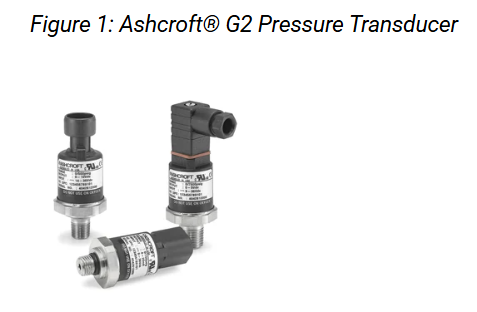
The G2 is designed for demanding high-pressure applications requiring durability, accuracy and high immunity to electrical interference. This transducer is frequently chosen for mobile hydraulics, industrial equipment and systems requiring higher pressure ranges up to 20,000 psi.
Key Features & Benefits
- All-welded stainless-steel sensor and pressure connection. Eliminates leak paths and ensures long-term resistance to pressure cycling and fatigue.
- Stainless steel thin-film CVD sensor technology. Provides long-term stability, reduced drift and excellent performance under high cycle counts along with survivability in shock and vibration type intense environments.
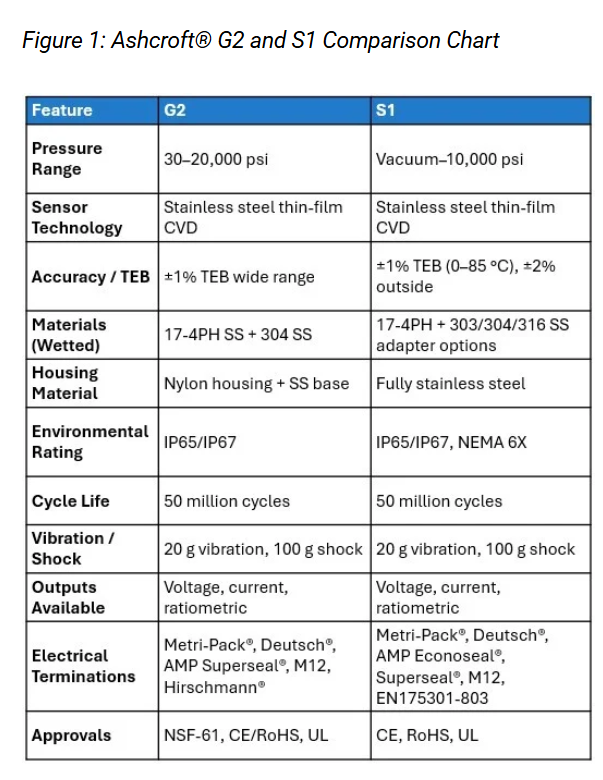
- Wide pressure range (30–20,000 psi). Supports ultra-high-pressure systems without requiring specialized housings.
High EMI/RFI immunity. Protects signal integrity in engine compartments and electrically noisy environments. - IP65 or IP67 ingress protection depending on electrical connector used. Withstands exposure to dust, water spray and outdoor conditions.
- Durability: 50 million pressure cycles. Extends service life in continuous-duty hydraulic and pneumatic systems.
Multiple output options (4–20 mA, 0–5 Vdc, 0–10 Vdc, ratiometric). Supports integration into both analog and ECU-based control systems. - Diverse electrical connections. Simplifies integration into OEM wire harnesses.
- Nylon housing with all stainless-steel wetted parts. Reduces weight while maintaining chemical compatibility and strength.
Typical Applications
- Off-road vehicles
- Construction machinery
- Hydraulic and pneumatic sensing
- Performance racing
- Railroad/transportation
- HVAC/R
- Process automation
- Pump monitoring
The S1 OEM Pressure Transducer
This transducer is engineered for OEMs needing a high-quality, rugged and economical pressure transducer for medium- to high-volume production. The S1 offers broad configurability with multiple housings, connections, and output options.
Key Features & Benefits
- Stainless steel thin-film CVD sensor technology. Provides long-term stability, reduced drift and excellent performance under high cycle counts along with survivability in shock and vibration type intense environments.
- Accuracy based on TruAccuracy™ terminal-point method. Eliminates need for field calibration and ensures consistent performance out of the box.
- Pressure ranges from vacuum to 10,000 psi. Flexible for both low-pressure and high-pressure OEM applications.
Fully stainless-steel sensor element and housing options (304/316). High corrosion resistance suitable for harsh or wet environments. - High EMI/RFI immunity. Maintains signal integrity in electrically noisy systems.
- IP65 or IP67, NEMA 6X rating depending on connector. Strong resistance to washdown and outdoor exposure.
- Durability: 50 million pressure cycles support long equipment lifecycles even under constant cycling.
- Highly configurable electrical terminations. Allows standardized integration across multiple OEM product lines.
Typical Applications
- Mobile hydraulics
- Construction machinery
- Hydraulic/pneumatic systems
- Transportation
- Agriculture equipment
- Industrial automation
- Performance racing
- HVAC/R
- Pump monitoring

Choose the G2 if your application requires:
- Pressure ranges above 10,000 psi
- Higher accuracy over a wider temperature span
- Lightweight housing with stainless steel wetted parts
- Strong EMI/RFI immunity for demanding electrical environments
- A rugged design optimized for mobile and industrial hydraulics
Choose the S1 if your application requires:
- High-volume, cost-sensitive manufacturing
- Broad configurability of housings, materials, and connectors
- Stainless steel housing for corrosive or wet environments
- Consistent out-of-box accuracy with no calibration required
- Pressure ranges up to 10,000 psi with high repeatability
Talk to one of our experts today at (855) 737-4715 or fill out our online form to learn more.