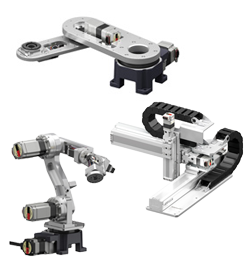
 Industrial automation has an odd habit of swinging between two extremes. On one end are simple motion axes that are easy to integrate but limited in flexibility. On the other end sit large industrial robots that are powerful but often overkill for a machine builder who just needs reliable part handling inside a compact piece of equipment. The Oriental Motor OVR Series robots land right in the useful middle.
The OVR Series provides compact industrial robots designed specifically for machine integration, small-part handling, and precision positioning. These robots combine Oriental Motor’s motion control expertise with robot architectures such as SCARA, articulated, and Cartesian configurations, giving engineers flexible automation options without the complexity of traditional robotic systems.
Because the robots use Oriental Motor’s integrated AZ Series step-servo motors and MRC robot controllers, system design stays straightforward. Communication over standard industrial networks such as EtherNet/IP allows the robots to work easily with PLCs, vision systems, and other automation components. Engineers can also use free simulation software to program and validate motion before installing the robot in the machine.
The result is a robot platform that is compact, easy to integrate, and practical to maintain, making it well suited for applications such as pick-and-place, inspection, electronic assembly, packaging, and laboratory automation. For machine builders and manufacturers who need robotic capability without unnecessary system complexity, the OVR Series offers a simple and effective path to automation.
Options
OVR Robot Options
SCARA Robots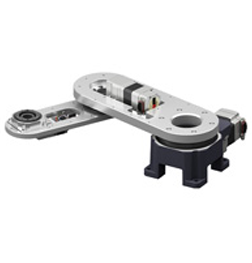 SCARA (Selective Compliance Assembly Robot Arm) uses a parallel Z-axis combined with "compliant" X-Y axes to provide accurate movement in confined areas. The pedestal mount creates a small footprint, and the SCARA robot is typically faster than a Cartesian Robot. Oriental Motor's 3-Axis SCARA Robots combined with our MRC robot controllers and MRC Studio Software allow for simple control and performance in a complete robot solution.
The OVR Series SCARA 3-axis small horizontal transport robot features a simple mechanism that can be easily controlled and constructed cost-effectively. SCARA uses a parallel Z-axis combined with compliant X-Y axes to provide accurate movement in confined areas. The pedestal mount creates a small footprint, and the SCARA robot is typically faster than a Cartesian Robot. Control with the MRCU Integrated Robot Controller & Drivers.
- Approach narrow spaces (compared to general SCARA robots)
- Lightweight and flat with chassis mass of 7.6 ~ 8.9 kg and a height of 137 ~ 205 mm
- Transportable mass 3 ~ 10 kg
- 2 moving range types: ±170 deg or ±360 deg
- Simple dust-resistant structure available
- The use of mounting brackets expands the operating range in the vertical direction
Articulated Robots Articulated Robots utilize rotary joints (axis) that allow for more degrees of freedom than other robot types. Articulated Robots structure provides an enhanced range of motion meant to mimic a human arm. This allows a lot of flexibility in the applications they can support in manufacturing and industrial applications. These robots are the most common robot type used in industrial applications because they can perform many different types of tasks with high precision and speed.
Oriental Motor offers 4, 5 or 6-axis robots that can utilize a wide range of end effectors to meet your specific application needs. In addition, our MRC robot controllers and MRC Studio Software allow for simple control and performance in a complete robot solution.
The OVR Series Articulated 4-axis, 5-axis, and 6-axis small horizontal transport robots feature a simple mechanism that can be easily controlled and constructed cost-effectively. Control with the MRC Series controller and AZ Series motor drivers.
- Parallel link mechanism
- Transportable mass 1 ~ 5 kg
- Compact and lightweight
- Can be combined with an electric linear slide for horizontal travel (5-axis and 6-axis)
Cartesian / Gantry Robots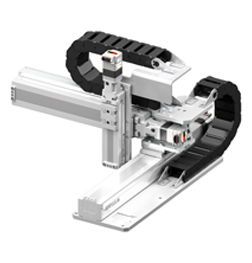 Cartesian Robots, also known as Gantry or Linear Robots, utilized three linear, sliding joints to move through a 3-dimensional space. These robots utilize rigid joints that are each perpendicular to each other provide high reliability and precision for X-Y-Z movement.
Oriental Motor's 3-Axis Cartesian Robots combined with our MRC robot controllers and MRC Studio Software allow for simple control and performance in a complete robot solution.
The OVR Series Cartesian / Gantry 3-axis small robot features a simple mechanism that can be easily controlled and constructed cost-effectively. Control with the MRC Series controller and AZ Series motor drivers.
- Delivered with three linear slides assembled, reducing equipment startup time and labor
- Moving range 300 mm × 300 mm × 100 mm (X-Y-Z)
- Transportable mass 2.5 kg
Features
Features & Capabilities
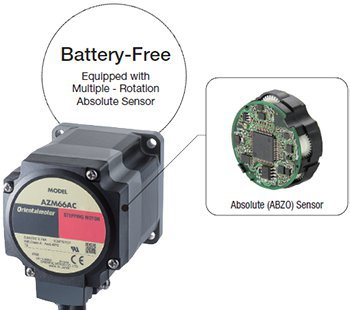 Built-in Battery-Free Absolute Encoder
The αSTEP AZ Series (DC input) is used for all axes. No external sensors are required, simplifying the wiring. No battery is needed, so maintenance can be reduced.
Easy Maintenance
Some motors can be replaced by the customer. This cuts down on the burden of maintenance (both cost and time) after deployment.
Easy Setup, Even for Beginners
Small robots OVR can help reduce setup time because dimensional data, such as arm length, is already registered.
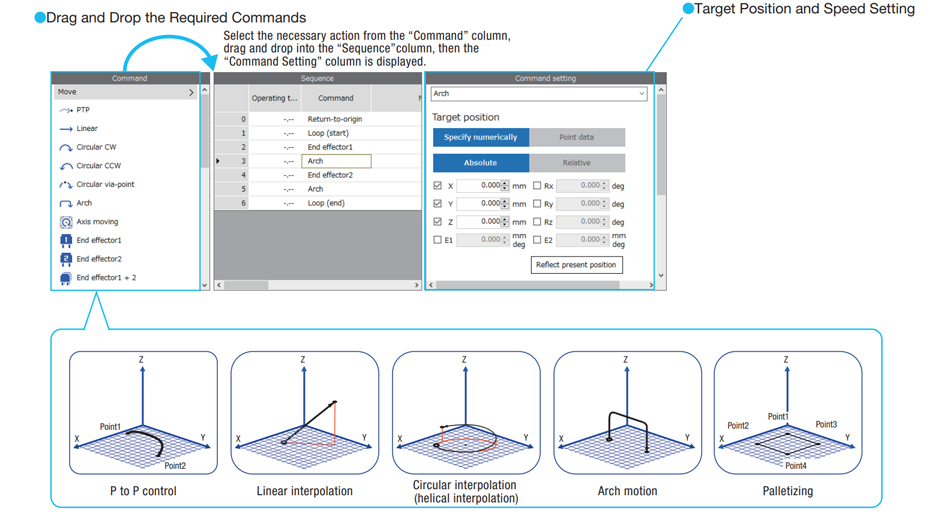
Say Goodbye to Ladder Logic! Operation Programming with Item Selection
Program creation uses a simple command selection format. Programs can be created intuitively, without requiring specialized knowledge such as ladder diagrams. The system supports a range of advanced motion control operations, including P-to-P, linear interpolation, circular interpolation, and arc motion, among others. Operating data is executed directly from a host controller via EtherNet/IP
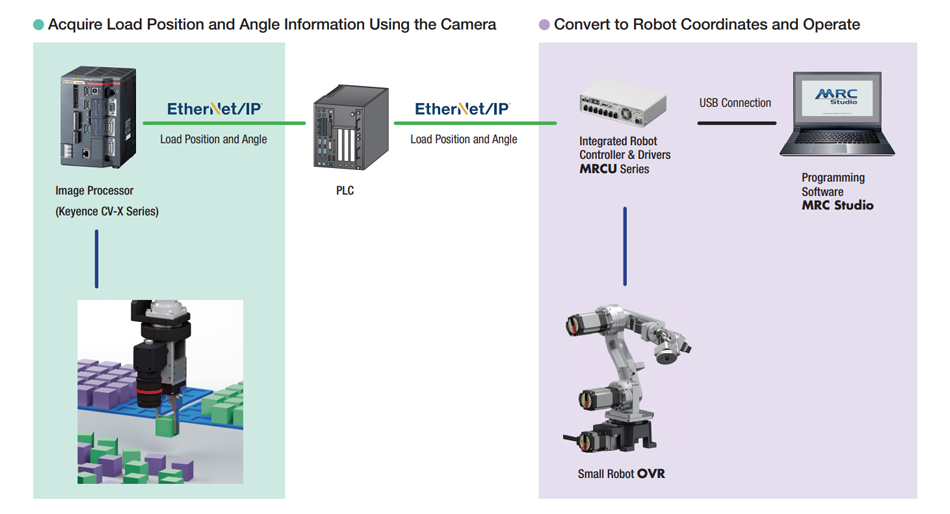
Configuration of a Robot Vision System Using 2D Cameras
The robot controller is equipped with useful functions for operating the robot using load position and angle information acquired by the camera.
In order to integrate the 2D camera, MRC Studio is used to perform the calibration* in advance. The settings can be easily configured by simply following the on-screen instructions while looking at the illustrations, allowing for a reduction in the work hours necessary for correction.
*Up to two motors
Applications
Applications & Industries
Small Robots OVR are designed to support internal logistics across a wide range of industries where reliable material movement is essential.
- Manufacturing: Automate the transport of components, subassemblies, and finished goods between production cells.
- Electronics Assembly: Move delicate parts and assemblies between testing, inspection, and packaging stations with precision.
- Semiconductor and High-Tech Production: Support clean, organized material flow in environments requiring consistent and repeatable transport.
- Laboratories & Medical Device Production: Transport samples, tools, and equipment between workstations while minimizing manual handling.
- Warehousing & Distribution: Improve picking and staging efficiency by automating short-distance material transport.
Q & A
OVR Robots Q & A
The Oriental Motor OVR Series is a family of compact industrial robots designed for automated handling, inspection, and small-part assembly. The lineup includes SCARA, articulated, and Cartesian robots, each designed with a simple mechanical structure that enables easy control and cost-effective automation. These robots integrate with MRC Series robot controllers and AZ Series motor drivers for streamlined programming and operation.
The OVR Series includes three primary robot architectures:
- SCARA Robots: 3-axis robots optimized for high-speed pick-and-place and assembly in confined spaces.
- Articulated Robots: 4-axis, 5-axis, and 6-axis robots that use rotary joints to provide flexible movement similar to a human arm.
- Cartesian / Gantry Robots: 3-axis robots that move along linear X-Y-Z axes and are ideal for precise positioning and structured workspaces.
These configurations allow users to select the robot type that best matches their application requirements.
OVR robots are commonly used in automation applications involving small parts and precision handling, including:
- Pick-and-place operations
- Electronic component assembly
- Inspection systems
- Packaging automation
- Laboratory and medical equipment automation
- Semiconductor and electronics manufacturing
Their compact design makes them particularly effective in machines with limited installation space or retrofits of existing equipment.
The OVR Series robots provide several benefits for machine builders and automation engineers:
- Compact and lightweight design with robot bodies as light as about 7.6–8.9 kg
- Small installation footprint and flat profile for tight spaces
- Simple control architecture using integrated robot controllers
- Cost-effective automation solution compared with larger industrial robots
- Flexible mounting options, including floor, wall, or ceiling installation depending on model
These characteristics make them well suited for small automation cells or equipment integration.
Payload capacity depends on the robot configuration:
- SCARA robots: approximately 3–10 kg payload depending on model
- Articulated robots: typically 1–5 kg payload
- Cartesian robots: around 2.5 kg payload
These payload ranges make the OVR Series ideal for small-part handling, component transfer, and precision assembly tasks.
OVR robots are typically controlled using Oriental Motor’s MRC Series robot controllers, such as the MRC01 or MRCU integrated controller. These controllers work with AZ Series step-servo motors and can be programmed and tested using MRC Studio software. This integrated ecosystem simplifies setup, programming, and maintenance.
Yes. The OVR Series is designed for easy integration into existing machinery or new automation systems. The robots feature compact footprints, flexible mounting options, and simple control architecture, allowing them to be installed without major redesign of existing production lines.
OVR robots use flat, lightweight designs and compact arm mechanisms, allowing them to operate in spaces where traditional industrial robots may not fit. Some SCARA models are specifically engineered to approach narrow work areas while maintaining accurate movement and positioning.
Yes. Certain OVR robot configurations can be combined with electric linear slides or other motion components to expand the robot’s working range or add additional axes for horizontal transport or positioning tasks.
The Oriental Motor OVR Series small robots are designed to make robotic automation easier to integrate into machines and production systems. Their compact mechanical design, simple control architecture, and practical serviceability features help machine builders deploy robotics without adding unnecessary system complexity.
OVR Series robots using the MRCU controller can communicate over EtherNet/IP, which makes it straightforward to integrate machine vision systems or PLC-based automation platforms. A vision system can identify a part location and send position data directly to the robot controller over the network.
Because EtherNet/IP is widely used in industrial automation, engineers can add vision-guided positioning without building complex communication bridges or custom interfaces.
The mechanical design of the OVR Series provides easy access to the motors, allowing technicians to inspect or service them during routine maintenance.
This accessibility reduces the time required for inspections and helps minimize machine downtime, since maintenance tasks can often be performed without major disassembly of the robot.
Yes. Oriental Motor provides simulation software at no additional cost.
Engineers can use the software to program motion sequences, verify reach and workspace, and simulate robot operation before the machine is built. This allows potential issues to be identified early in the design process and can significantly shorten commissioning time once the system is installed.
Additional advantages include:
- Compact footprint that fits easily into machinery and automation cells
- Lightweight robot construction that simplifies mounting and integration
- Integrated motor and controller architecture that reduces system complexity
- Cost-effective automation for small-part handling and assembly applications
These characteristics make the OVR Series a practical solution for machine builders and manufacturers who want to add robotic capability without introducing unnecessary complexity to their systems.
Compact industrial robots like the OVR Series are commonly used in:
- Semiconductor manufacturing
- Electronics assembly
- Medical and laboratory automation complexity
- Food and packaging equipment
- Small-part manufacturing and inspection
Their ability to automate repetitive handling tasks helps manufacturers improve productivity, consistency, and throughput.
If you have any questions or are just looking for some help, we're happy to discuss your application with you. Reach out to us at (855) 737-4716 or fill out our online form.