Reliable Point Level Detection for Liquids & Solids
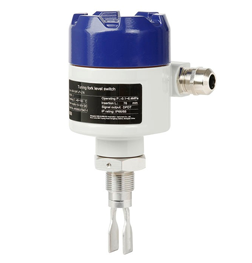 WIKA vibrating level switches provide dependable point-level detection in a wide range of industrial applications. Designed for accuracy, durability, and ease of installation, these switches are ideal for overfill protection, pump control, and dry-run protection in both liquid and bulk solid processes.
With robust construction and minimal maintenance requirements, WIKA vibrating level switches deliver consistent performance even in challenging environments involving temperature extremes, pressure fluctuations, or aggressive media.
Features
Key Features & Benefits
- Independent of Media Properties
WIKA vibrating level switches are largely unaffected by density, conductivity, dielectric constant, foam, bubbles, or turbulence—ensuring reliable operation in dynamic process conditions. - Rugged Industrial Design
Built with stainless steel housings and robust sensing elements, these switches are engineered for long service life in harsh industrial environments. - Minimal Maintenance
With no moving mechanical parts and no need for recalibration, vibrating level switches from WIKA offer low total cost of ownership. - Fast & Accurate Switching
Immediate response to level changes makes these switches ideal for safety-critical applications such as overfill prevention. - Flexible Installation Options
Available with multiple process connections, mounting orientations, and output signals to fit existing systems easily.
Applications
What Are Vibrating Level Switches?
Vibrating level switches operate using a tuning fork or vibrating rod that oscillates at a fixed frequency. When the sensor comes into contact with process media, the vibration frequency changes, triggering a switching signal.
This simple yet highly reliable measurement principle makes vibrating level switches suitable for a wide range of applications where dependable point level detection is required.
Typical Applications
- Overfill protection in tanks and vessels
- Minimum or maximum level detection
- Pump and valve control
- Dry-run protection for pumps
- Level monitoring in silos, hoppers, and pipelines
Suitable Media
- Liquids (including oils, water, chemicals, and process fluids)
- Powders and fine-grained bulk solids
- Media with changing density or conductivity
Performance
Technology & Performance
Proven Vibrating Fork Technology
WIKA uses precision-engineered vibrating fork and rod designs that maintain stable oscillation frequencies. When covered by product, the damping effect reliably signals a level change without false triggering.
Performance Advantages
- High repeatability and switching accuracy
- Stable operation under pressure and temperature variation
- Resistant to coating, buildup, and vibration from external sources
Certifications & Compliance
WIKA vibrating level switches are available with industry-recognized approvals, making them suitable for:
- Hazardous areas
- Safety-related applications
- Global industrial installations
Q & A
Vibrating Level Switches Q & A
Downloads
Download Vibrating Level Switch Datasheet
Talk to one of our process control experts today at (855) 737-4714 or fill out our online form to learn more.