Q&A Section with Expand/Collapse IconsType 350 Stainless Steel Air Filter Regulator from ControlAir Q & A
+ What are the key specifications of the Type 350 stainless steel filter regulator, and how do I know if it fits my application?
The Type 350 Stainless Steel Air Filter Regulator is built for high‑performance industrial use. It comes in ¼″ or ½″ NPT port sizes. Its maximum supply pressure is 290 psig (20 bar) in the standard version. It offers output ranges of 0‑30 psig (0‑2 bar), 0‑60 psig (0‑4 bar), 0‑100 psig (0‑7 bar), and 0‑150 psig (0‑10 bar). The maximum flow capacity is up to 150 scfm (4,247 Nl/min) when using the ½″ ports. Filter ratings include a 25 micron standard, optional 5 micron. Ambient temperature ratings cover from –61 °F (–52 °C) in the low‑temperature option up to +194 °F (90 °C). To determine if this regulator suits your application, check that your system’s inlet pressure does not exceed the 290 psig rating, that your required output pressure falls within the available range, that your flow demand does not exceed ~150 scfm for the ½″ size (or ~50 scfm for ¼″ depending on conditions), and that the environment (temperature, gas type, corrosive conditions) matches the stainless steel specification and offered options (like low‑temperature, autodrain, sour‑gas compatibility).
+ What materials and environment‑resistance features does the Type 350 offer, and is it suitable for harsh or corrosive industrial environments?
Yes — the Type 350 is designed for harsh and corrosive environments. Its body and major wetted parts are made from 316L stainless steel for superior corrosion resistance and suitability for sour‑gas or offshore environments. It meets the NACE MR0175 requirements for sulfide stress cracking (important in oil & gas, sour‑gas applications). The diaphragm and seals use fluorocarbon materials, and optional low‑temperature accessories provide service down to –61 °F (‑52 °C). Additional options like automatic drain for heavy condensate environments are available. If your installation is in a chemical plant, offshore platform, water treatment facility, or other corrosive/low‑temp environment, the Type 350 offers a robust solution – provided you choose the correct options and materials for your specific conditions.
+ Which filter element rating (25 micron vs 5 micron) should I select, and what is the maintenance schedule?
The Type 350 comes standard with a 25 micron depth filter, with the option to select a 5 micron filter for applications requiring very clean supply air. If your application involves precise instrumentation, pneumatic control valves, or sensitive automation equipment, selecting the 5 micron option ensures better protection. On the other hand, if your air supply is already relatively clean and used for general industrial regulation, the 25 micron may suffice. As for maintenance: monitor the filter bowl for condensate or trapped particulates, drain or clean regularly (especially if condensate load is high), inspect differential drop across the filter, and replace or clean the filter element when performance starts to degrade (for example, pressure drop increases or regulation becomes unstable). Because the unit supports harsh environments and high flows, more frequent inspection may be required in wet or dirty air systems. Always follow the manufacturer’s instructions for maintenance and element replacement.
+ How is the Type 350 installed (port size, mounting, plumbing), and what accessories do I need for U.S. installations?
The Type 350 installs with either ¼″ or ½″ NPT inlet and outlet ports, depending on the model selected. It supports pipe‑mounting or bracket‑mounting. Standard best practice: ensure the direction of flow is from “IN” to “OUT” as marked on the body, clean upstream piping to remove debris before installation, and align the drain port downward if using manual or automatic drain. Accessories often needed include a stainless steel pressure gauge (for monitoring the regulated outlet), a mounting bracket kit, and possibly remote vent tubing if required. The manufacturer supplies compatible accessory part numbers for these. On the plumbing side, use appropriate sealing tape or compound (avoiding contaminating the regulator interior), and ensure the supply air is within specification (pressure, cleanliness, condensate‑free). For U.S. industrial installations, make sure you conform to relevant safety codes and any local regulations for pressure equipment. Proper mounting and plumbing will enable the Type 350 to perform reliably and avoid leaks or misinstallation issues.
+ When should I choose the Type 350 stainless steel regulator rather than a more basic model, and what are the trade‑offs?
You should choose the Type 350 when your application demands high corrosion resistance (316L stainless steel), high flow capacity, sour gas compatibility, or low‑temperature service down to –61 °F (‑52 °C). It is ideal for industries such as oil & gas, offshore platforms, water/wastewater treatment, chemical processing, food & beverage, where stainless and harsh‑service ratings are required. The trade‑offs: stainless steel construction and the advanced options typically cost more than standard aluminum regulators; flow/port size may still be a limiting factor compared to extremely large‑flow regulators; if your environment is non‑corrosive, ambient temperature benign, and flows modest, a simpler, more economical aluminum regulator may suffice. The key is matching your demands (corrosion, gas type, temperature, flow) to the regulator’s specification. If you don’t need the full stainless steel harsh‑service features, then a lower-cost unit may deliver sufficient performance. But for harsh environments, the Type 350 offers premium durability and specification adherence.
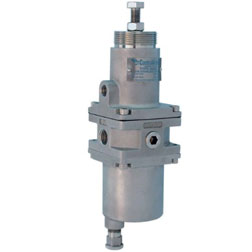 The Type 350 stainless steel air filter regulator (AFR) is designed to stand up to the harshest environments, while providing highly accurate pressure regulation. By using proven 316L stainless steel for the housing and filters, along with the use of fluorocarbon-fiber reinforced diaphragms, the Type 350 is compatible with sour gas and offshore environments. The Type 350 regulators meet NACE MR0175 requirements for sulfide stress cracking. Each of these products is built and tested at our facility to ensure you get the best quality, at a great value, with the best service.