
The Many Layers of Performance and Specifications in Motion Control – Critical Elements of System Integration
This series has focused on high-precision motion control. In such applications, system performance is often judged simply by the specifications of the mechanics alone. The actuators are typically sorted by a standard set of specifications such as repeatability, accuracy, and load capability. For many applications, this is all that’s required. Others will need an understanding of those specifications to make sure the basic assumptions for them are met during installation. Achieving true precision, however, requires a deeper understanding of the full motion control system from the mechanics to the motors, drives and controls.
Here we continue to explore how each layer of technology contributes to the overall system performance. The first article in the series looked at the mechanics, examining critical factors that are often overlooked such as bearing deflection, body stiffness, and structural smoothness. The second article looked at the motors, examining their designs, construction, quality and other factors. In the third part of the series, the discussion focused on the importance of the designs and features of drives and controls for the system. Lastly, here in the fourth and final article, we end with the critical elements of the system integration itself.
A common theme running throughout all such cases is that there are details that do not show up on data sheets but can make or break the high-performance expectations of the entire system. As motion systems push beyond micron-level accuracy, traditional specifications start to lose their typical meaning and relevance, making nuanced engineering decisions essential. This series aims to help engineers, designers, and system integrators recognize just how important each decision is in putting a high-precision motion system together. In the previous articles, we discussed three general tiers of performance to consider in a motion control system: basic, specification-level, and pushing-beyond-the-specifications performance. This even applies to the integration of the components.
System Integration: You Don’t Get Precision by Accident
Many ideas get thrown together and they just work; or at least at first. For example, the concept was good and the initial assembly proved it out. But as time wears on, problems may arise or a better level of performance is needed for the next generation of that same concept. If you’ve ever made a paper airplane, you get the point. You folded the paper into a simple airplane and it flew. Then, after repeated flights and crashes, it stops flying as well. And then you get the desire to make it fly farther and straighter. Now the folds have to be more precise, crisper and cleaner, even with the same initial design. With motion control systems, the same principle applies. Even the best-designed motion control sub-system will fall short if the overall system isn’t thoughtfully engineered or properly integrated. Optimal performance doesn’t come from the sub-system, but from the whole system itself.
Real-world Integration Failures
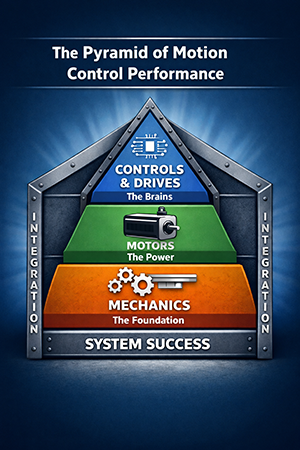 System integration is the art of making all the mechanics, motors, drives and control components work to their full potential in combination with the infrastructure of the rest of the system around them. Every specification of hidden assumptions that the system has to meet in order for those components to be able to perform to their stated specifications. For example, mechanical actuators assume certain flatness and stability of their mounting surfaces, while motors assume certain air flow and heat sink conditions. For drives and controllers, the assumption is that clean power is available.
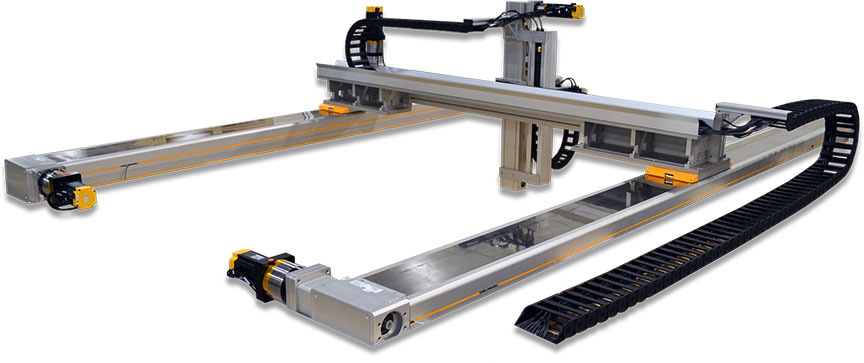
A precision linear motor is highly affected by its mounting surface and its alignment with the linear bearings that are holding the load. Using a linear motor with linear guides on both sides creates a three-component system that must be precisely aligned. If they are not, then mechanical binding can occur that, at best, creates uneven friction and wear and, at worst, creates binding that stops the motor from moving all together. Two long linear belt and pulley actuators that are parallel in a system have the same challenge as the linear motor and guides. However, they have an additional challenge of their travel lengths needing to be tuned to match each other. If their belt tensions vary, then the distance per revolution of the pulley will vary. This may be minor in the short travel, but over the course of two meters of travel, a 5-mm variance between the two actuators at the end of travel can be significant in a system requiring precise movements. Controllers and drives are usually integrated in lab or workshop environments where the electrical power is clean and strong so proper grounding techniques, shielding, and EMC filters may not be needed. Once that same system is deployed into the field however, those short cuts will allow dirty power sources to affect the performance of the system.
That same system assembled in the workshop may be getting installed in a hot environment. Hot environments can cause thermal expansion which can directly impact all the mechanical alignments and performance of the motors keeping the system from even getting close to meeting its performance requirements.
Integration Practices That Matter
For systems using precision motion control sub-systems, there are several practices that should be regularly implemented. The surfaces that actuators are mounted to need to meet the assumed standards of the actuators and the application itself. Dowel pins can be used between the actuators and their mounting surfaces which may include another actuator. This helps with the repeatability of the system’s assembly if and when it is disassembled and re-assembled.
For axes that will have encoders, whether they are linear, rotary, or ring-type encoders, proper alignment is often critical. Some of these require proper fixtures and measurement tools to ensure accuracy.
Cable routing is a discipline that is often overlooked. Lower-power signals should run separately and perpendicularly to the high-power signals. They should never be run in parallel in the same cable tray over long distances. Coiling up the extra high-power cable should also be avoided.
Ultra-high precision systems can easily be affected by the environment around them, so isolating them from that environment can be critical. Vibration dampers will help as will temperature-controlled rooms. The highest precision systems are used and measured in temperature-controlled rooms that are on separate foundations from the rest of the facilities around them.
Guiding Questions for Engineers
Here are some vital questions to consider during the integration process:
- What assumptions are buried in the product
specifications? - What performance dependencies exist between the
components and sub-systems? - Is one component or sub-system being over-specified
while another one is under-specified?
In the end, it is the questions unasked that will come back to haunt the system. If the application requires any sort of high-performance, be sure to think like a systems engineer, not a product selector.
Article featured in Design World Magazine
Be sure to check out the entire series:
Part 1: The Many Layers of Performance and Specifications in Motion Control - Mechanics
Part 2: The Many Layers of Performance and Specifications in Motion Control – Motors
Part 3: The Many Layers of Performance and Specifications in Motion Control – Drives and Controls
Part 4: The Many Layers of Performance and Specifications in Motion Control – Critical Elements of System Integration